|




Total Solar Eclipse
Alcañiz, Spain
August 12, 2026
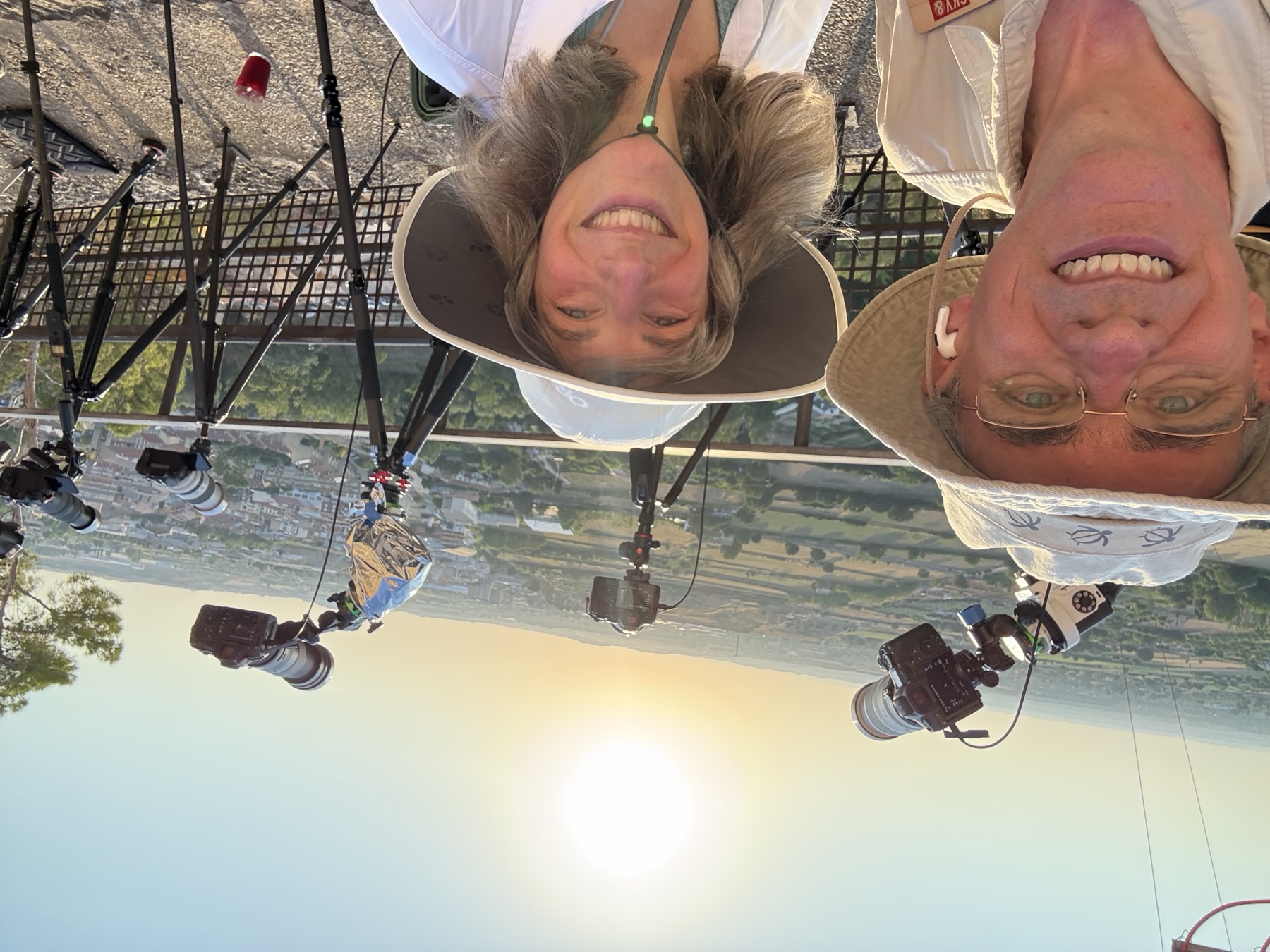
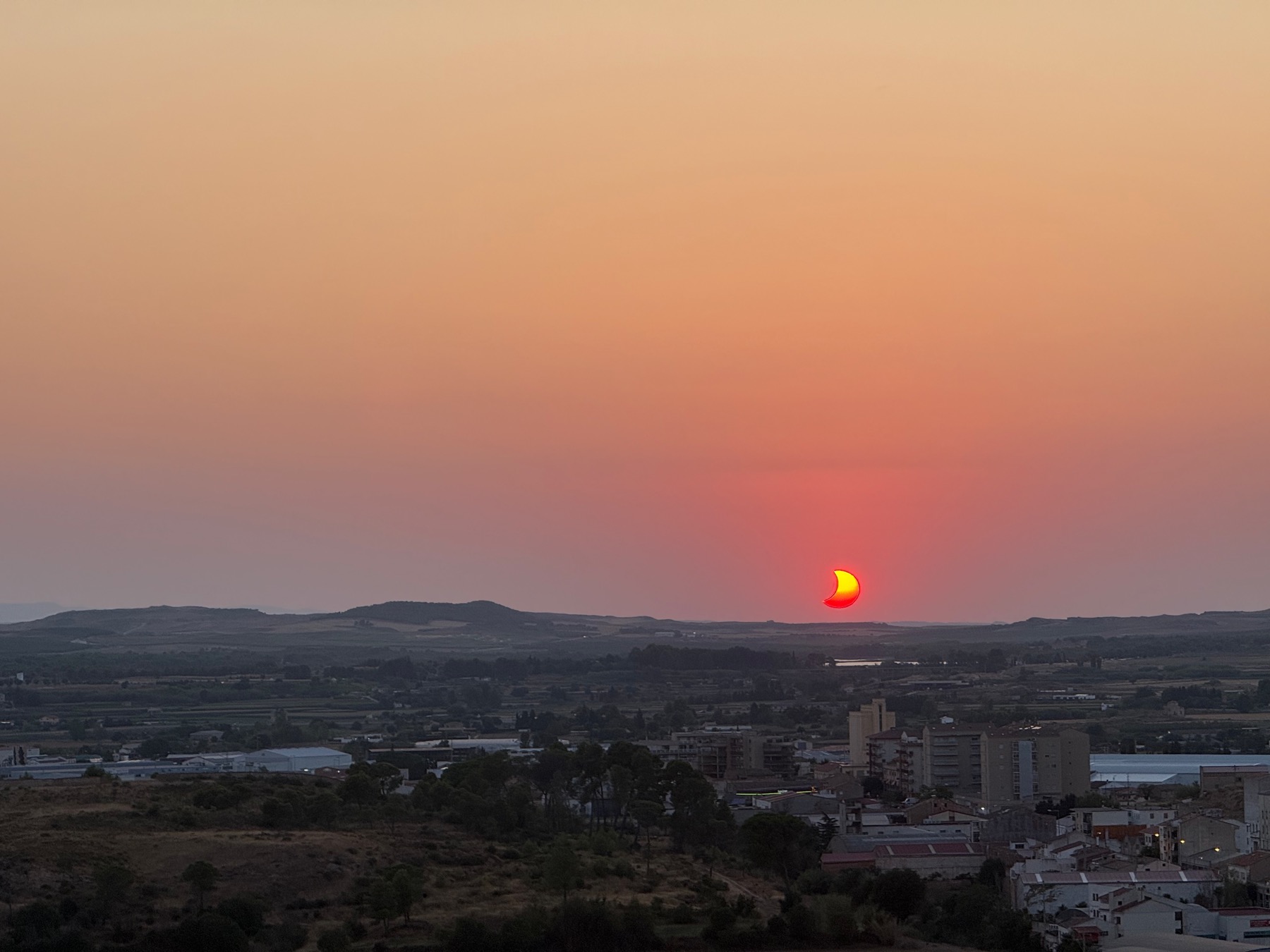
We observed our fifth total solar eclipse on August 12, 2026. Along with Cathy's mother, Barbara, we joined a Sky & Telescope tour that put us at the Parador hotel in a hilltop castle in Alcañiz, Spain. From our location, this eclipse happened 34 minutes before sunset with the sun just 5° above the horizon. This gave us a new perspective that we were excited to experience and photograph.
The view of the sun's corona is magnificent beyond words. To see the sun replaced with a black circle in the sky surrounded by the wispy corona is stunning.
Click on photos below to see a larger version.
Tom ran one camera and Cathy ran two, the three directly behind us in the photo. We had each written software to control our cameras, so once we had them set up, all we had to do was remove and replace the solar filters around totality.
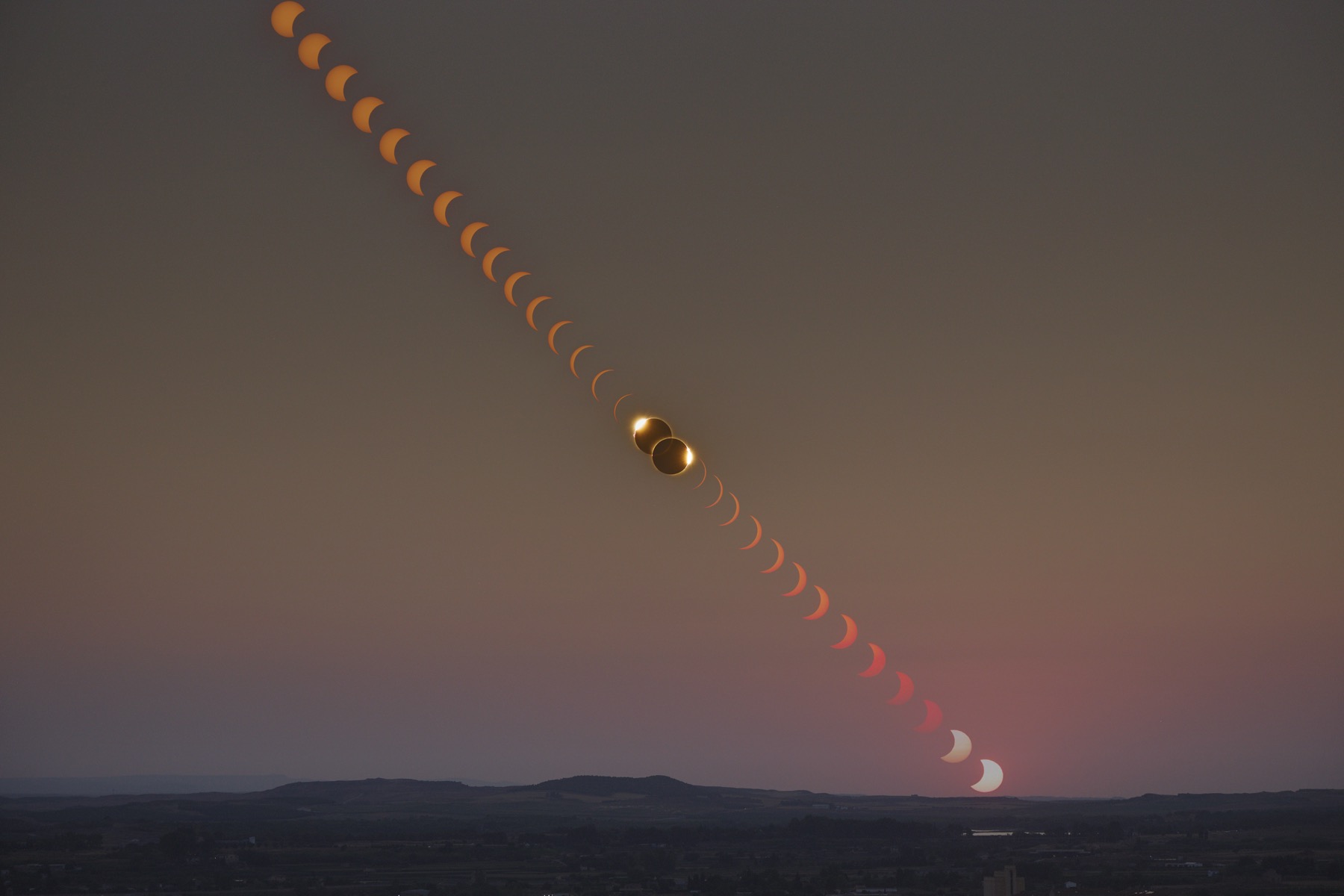
One of Cathy's cameras used a relatively wide lens (105mm) on a stationary mount to capture the sun and moon as they danced across the sky toward sunset. With that camera, she shot a series of photos of the partial phases before and after totality, using a solar filter that gave the sun an orange color. At the right time, she removed the filter so she could capture totality. Later, she also removed the filter to capture the sunset. From all of those photos, she created a timelapse showing the whole process.
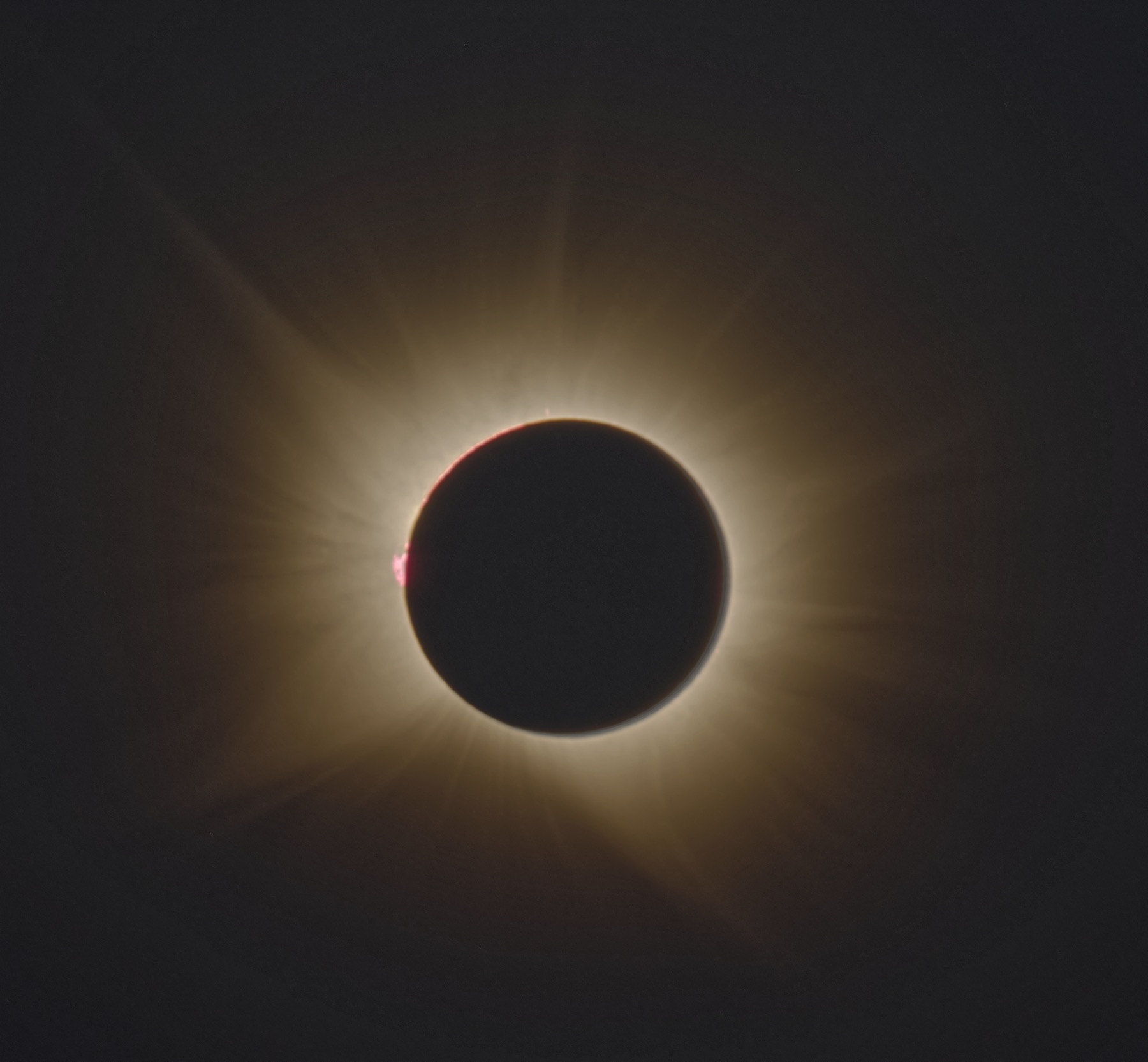
Our other two cameras used telephoto lenses on tracking mounts to photograph the eclipse in higher resolution.
The range of brightness during totality is more than a single camera image can capture, so to give an approximation of what we saw requires compositing multiple photos. This composite photo shows the structure of the sun's corona as well as the prominence located at 9 o'clock that was large and bright enough to be seen with the naked eye.
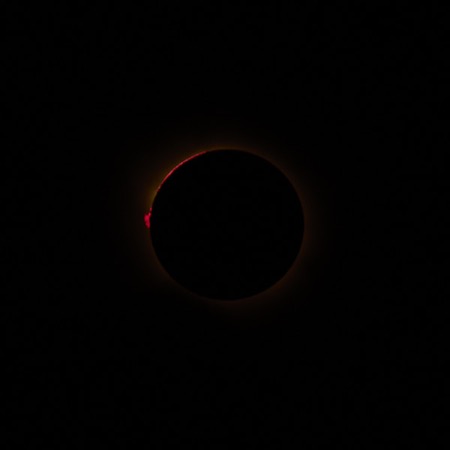
Here are 4 of the 13 photos used in the above HDR stack, illustrating the range of detail captured by different exposures. (Click on any photo to see a larger version.) The short exposure on the left shows the brilliant red prominence and chromosphere. As exposure is increased, more of the sun's corona becomes apparent. With the long exposure on the right, the faint wispy outer corona is revealed, but the brighter area near the sun's disc is overexposed, losing the detail of the inner corona.
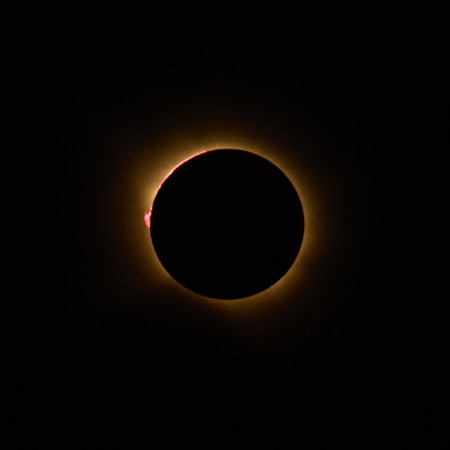
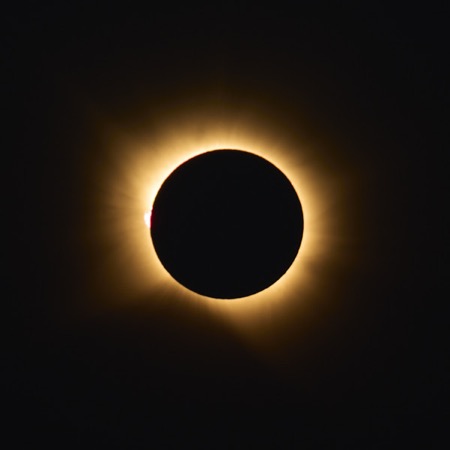
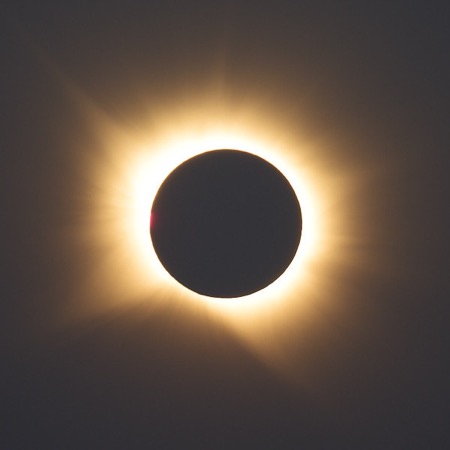
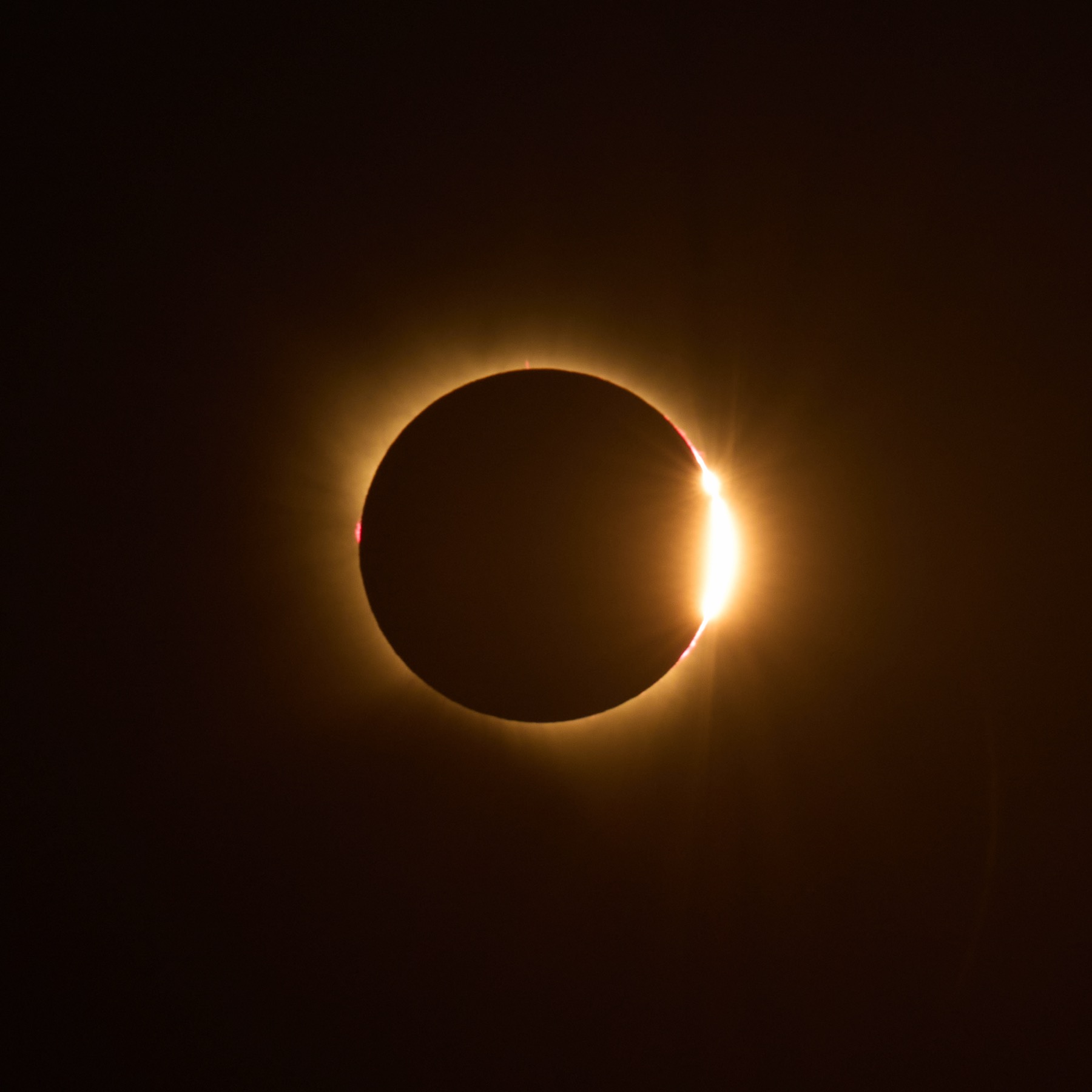
At the onset of totality, as the last bit of the sun is covered by the moon, two interesting effects occur: diamond ring and Baily's beads. Diamond ring is perhaps the most visually stunning aspect of a total solar eclipse. As the moon moves to fully eclipse the sun, the bright inner corona becomes visible revealing a black circle in front of the sun. That last bit of the sun's surface still outshines the corona, making a brilliant spot on the edge of the black circle, creating a fleeting image that looks like a diamond ring viewed from the side.
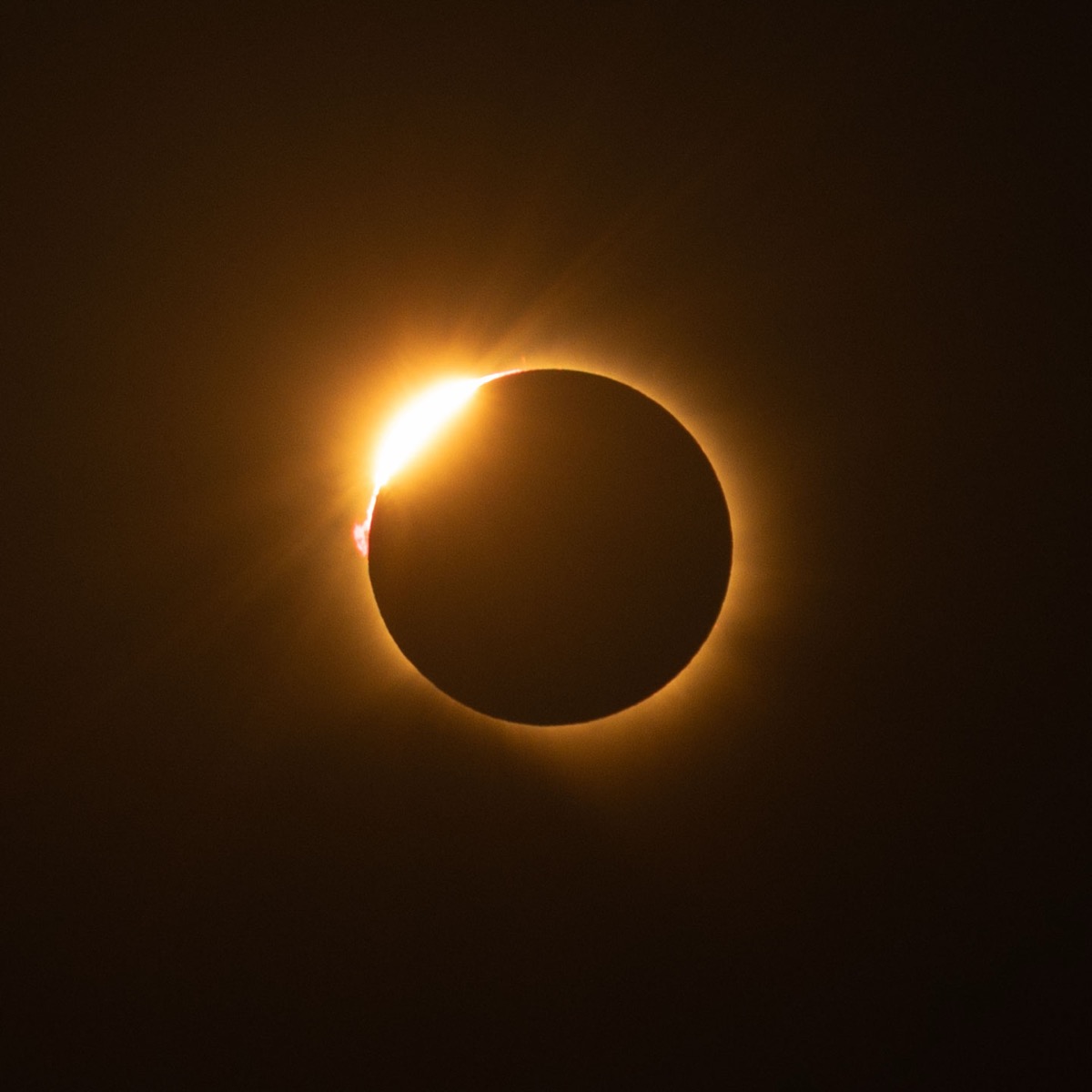
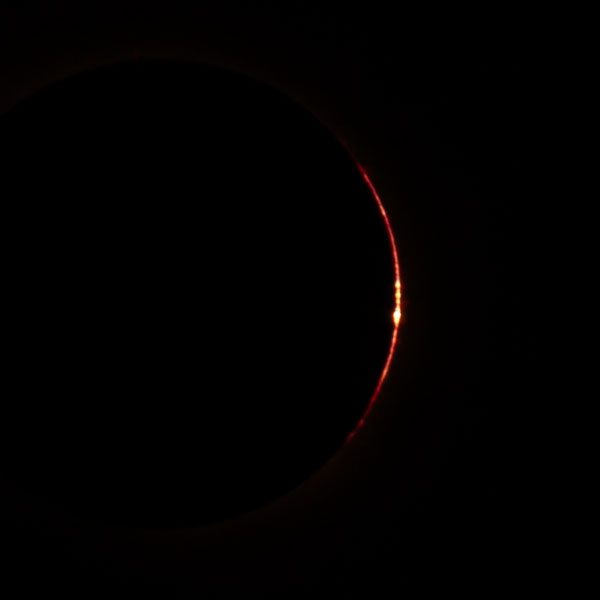
During this same period just before totality, it's possible to see more detail as the last of the sun is covered. The moon's surface has craters, valleys and mountains, so its edge is jagged. The very last part of the sun to peek through the eclipsing moon is seen through the valleys along the moon's edge. This final series of discrete bright dots forms Baily's beads. Seeing them requires a short camera exposure, or perhaps just the right filter, so that the extreme brightness of those dots doesn't blend into a single blob. Because these beads of light depend on the precise orientation of the moon toward the Earth and how it moves relative to the sun, Baily's beads are different for every eclipse.
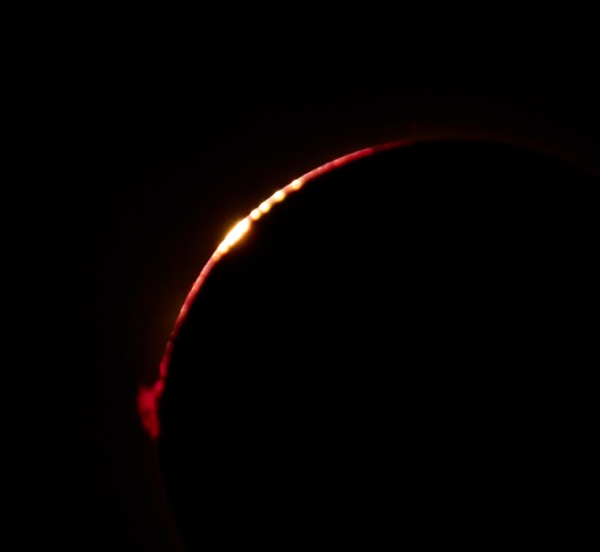
There is a second occurrence of both diamond ring and Baily's beads at the end of totality as the sun first emerges from the trailing edge of the moon.
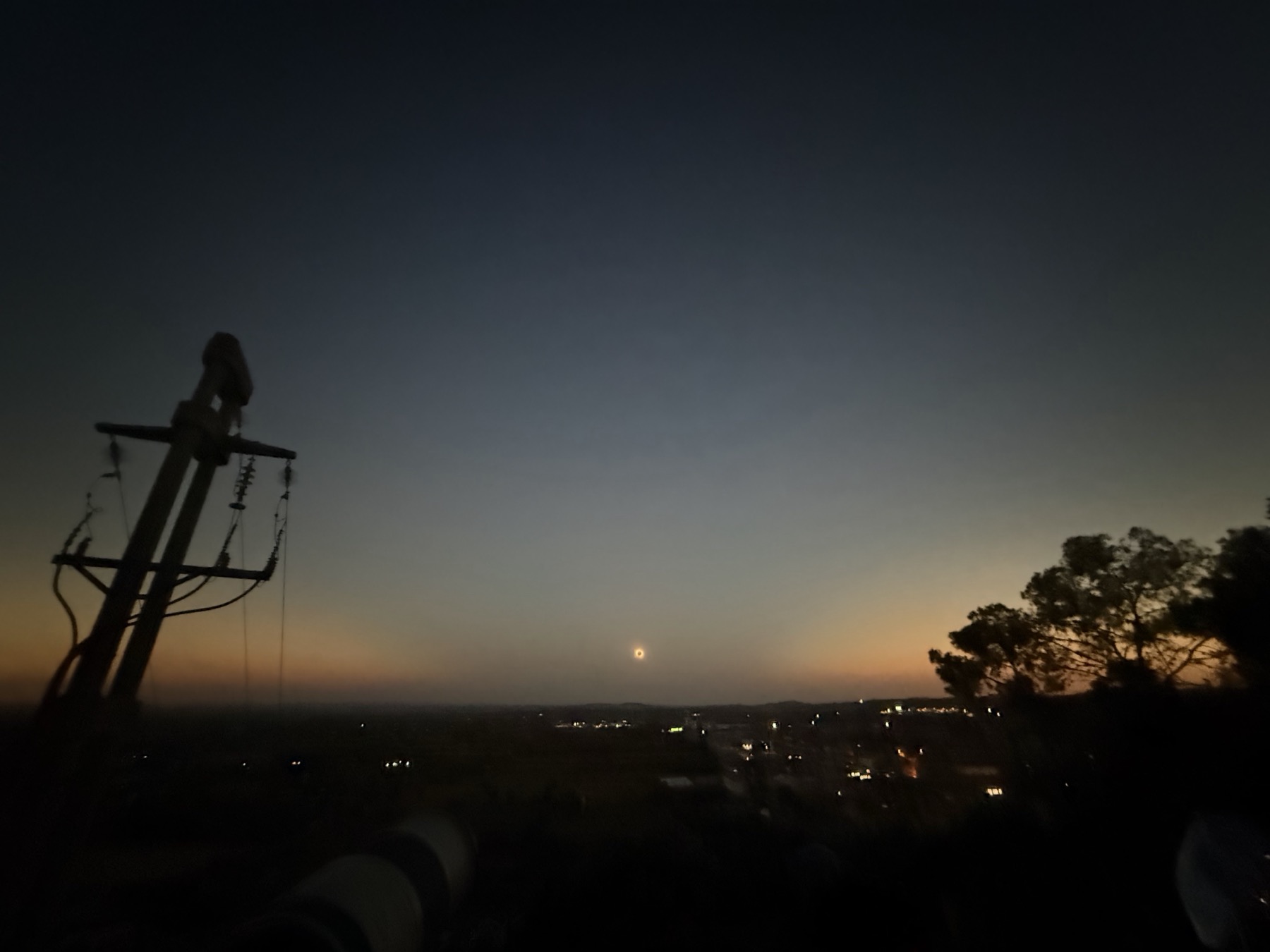
Because totality occurred so low in the sky, the moon's shadow was coming at us at an almost horizontal angle. This allowed us to clearly see the shadow in the sky, contrasting with the brighter parts of the sky on either side of the shadow.
The final treat was seeing the partially eclipsed sun sinking toward the horizon, turned red by the slightly hazy atmosphere augmented with lingering wildfire smoke.
Frequently Asked Questions
Why is one of the camera mounts wrapped in mylar?
It was hot in Spain, over 100° F before the eclipse started. Cathy wrapped her mount as a precaution to keep the drive and its batteries from overheating.
Why is the middle camera not on a tracking mount?
That was the camera Cathy used for the time lapse photographs.
What is the green blob on the strap below Cathy’s chin?
Great question! That's the green spot, an effect often seen when taking a photo of a bright light. It's a reflection/refraction of the bright light source that happens inside the camera lens. When that photo was taken, we were 28 minutes into the partial eclipse, just over halfway to totality. The sun is totally blown out in the photo, but the green spot is sufficiently less bright that if you click on the photo to see the full resolution version, you can see the shape of the chomped sun.
What tools did you use to process these photos?
We use Photoshop, Lightroom, Affinity, and Capture One to edit and process our images. Every pixel in every image came from photographs we took. We don't use any generative AI.
What equipment and other resources do you use for eclipse photography?
Our Eclipse Photography page lists our equipment and the online resources we use.
This page contains no AI content.
|
©1996-2026 Tom and Cathy Saxton. You may not copy or reproduce any content from this site without our consent.